
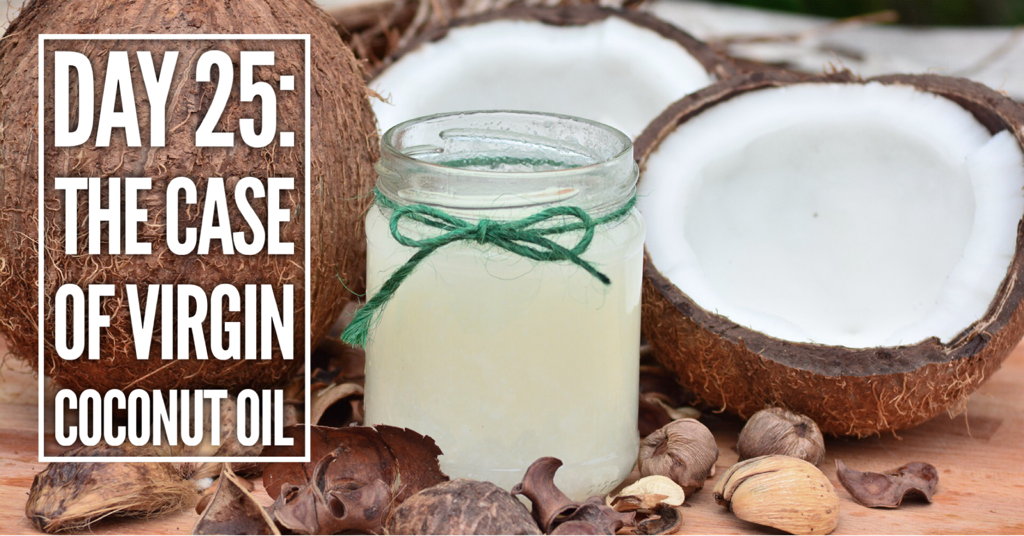
Day 25: The Case of Virgin Coconut Oil
We know that trans-fatty acids and hydrogenated fats are harmful. Whenever you look at the food label and see these in the ingredient list, please put them back on the shelf. Your heart and blood vessels will thank you.
Where do we see these hydrogenated oils and trans fats? Usually, the processed foods and baked goods rich in dairy fats and partial hydrogenation of corn oil. Palm oil is also a form of saturated fat with 16 carbons (palmitic acid) and is often used in commercial products.
What about medium-chain fatty acids? How does the body metabolize them?
Those with 8 to 10 carbon chains like caprylic and caproic are absorbed and transported via the portal circulation and cleared by the liver.
But the medium-chain fatty acid, lauric acid with 12 carbon chains, such as the one found in virgin coconut oil, is metabolized differently. One-third enters the portal circulation as free fatty acid, but two-third of which is transported via chylomicron as triacylglyceride.
The fate of triacylglyceride depends on what your body does with it. If your body needs it for energy (exercise, work, fasted state), it’s broken down and released for use. But if you have too
much of it, the VLDL remnant gets metabolized into LDL. So if you’re wondering where the high LDL from your lipid profile is coming from, it can be from too much saturated fat. The reason why virgin coconut oil is controversial and studies reveal different results is because it can both act as a substrate for good or bad fats. If you consume it and do not use it (sedentary lifestyle), your body stores it.
I take virgin coconut oil before I exercise. Even without breakfast, I can run or bike for an hour. But I don’t have enough scientific evidence to say it’s an excellent pre-workout food. This is merely anecdotal evidence. We still don’t have enough randomized controlled clinical trials to perform a meta-analysis to give us enough evidence of its actual cardiac benefits like the ones we’ve seen with omega-3 fatty acid as a precursor of eicosapentaenoic acid (EPA) and docosahexaenoic acid (DHA).
For now, we consume it in moderation and remember that 1 gm of oil is equivalent to 9 calories. It’s a good energy source, but the muscles need to be working to use the energy efficiently. Otherwise, it remains stored as fat.
Bottom line: Both the monounsaturated fatty acids and saturated fatty acids can be synthesized from protein and carbohydrates and therefore are NOT essential in our diet.
What is essential in our diet are the fatty acids that we cannot make, such as omega-3 and omega-6. And although omega-3 and omega-6 compete for the same enzymes to elongate their chains to make DHA, EPA (from omega-3), which are essential for membrane structure, our nervous tissue, retina, and even spermatozoa, and arachidonic acid (from omega-6), which is essential for acute inflammatory reaction and clotting mechanisms, the body preferentially converts omega-3 before it acts on omega-6 and oleic acid. So people who are concerned about inflammation should not avoid eating omega-6 rich food because we also need it for our body to function well. Just eat more omega-3-rich food.
In the Mediterranean diet, eating fish rich in EPA and DHA twice a week will add point to your score.
Click the link below on FDA’s advisory about fish consumption and which types of fish have high methylmercury that can be toxic for our bodies.
https://www.fda.gov/media/102331/download
Where do we see these hydrogenated oils and trans fats? Usually, the processed foods and baked goods rich in dairy fats and partial hydrogenation of corn oil. Palm oil is also a form of saturated fat with 16 carbons (palmitic acid) and is often used in commercial products.
What about medium-chain fatty acids? How does the body metabolize them?
Those with 8 to 10 carbon chains like caprylic and caproic are absorbed and transported via the portal circulation and cleared by the liver.
But the medium-chain fatty acid, lauric acid with 12 carbon chains, such as the one found in virgin coconut oil, is metabolized differently. One-third enters the portal circulation as free fatty acid, but two-third of which is transported via chylomicron as triacylglyceride.
The fate of triacylglyceride depends on what your body does with it. If your body needs it for energy (exercise, work, fasted state), it’s broken down and released for use. But if you have too
much of it, the VLDL remnant gets metabolized into LDL. So if you’re wondering where the high LDL from your lipid profile is coming from, it can be from too much saturated fat. The reason why virgin coconut oil is controversial and studies reveal different results is because it can both act as a substrate for good or bad fats. If you consume it and do not use it (sedentary lifestyle), your body stores it.
I take virgin coconut oil before I exercise. Even without breakfast, I can run or bike for an hour. But I don’t have enough scientific evidence to say it’s an excellent pre-workout food. This is merely anecdotal evidence. We still don’t have enough randomized controlled clinical trials to perform a meta-analysis to give us enough evidence of its actual cardiac benefits like the ones we’ve seen with omega-3 fatty acid as a precursor of eicosapentaenoic acid (EPA) and docosahexaenoic acid (DHA).
For now, we consume it in moderation and remember that 1 gm of oil is equivalent to 9 calories. It’s a good energy source, but the muscles need to be working to use the energy efficiently. Otherwise, it remains stored as fat.
Bottom line: Both the monounsaturated fatty acids and saturated fatty acids can be synthesized from protein and carbohydrates and therefore are NOT essential in our diet.
What is essential in our diet are the fatty acids that we cannot make, such as omega-3 and omega-6. And although omega-3 and omega-6 compete for the same enzymes to elongate their chains to make DHA, EPA (from omega-3), which are essential for membrane structure, our nervous tissue, retina, and even spermatozoa, and arachidonic acid (from omega-6), which is essential for acute inflammatory reaction and clotting mechanisms, the body preferentially converts omega-3 before it acts on omega-6 and oleic acid. So people who are concerned about inflammation should not avoid eating omega-6 rich food because we also need it for our body to function well. Just eat more omega-3-rich food.
In the Mediterranean diet, eating fish rich in EPA and DHA twice a week will add point to your score.
Click the link below on FDA’s advisory about fish consumption and which types of fish have high methylmercury that can be toxic for our bodies.
https://www.fda.gov/media/102331/download